
The Reports page displays menus of all reports which are currently available to you.
Since reports can be activated and deactivated on a per-client basis, and custom reports may be added for a client, the content of this page may vary.
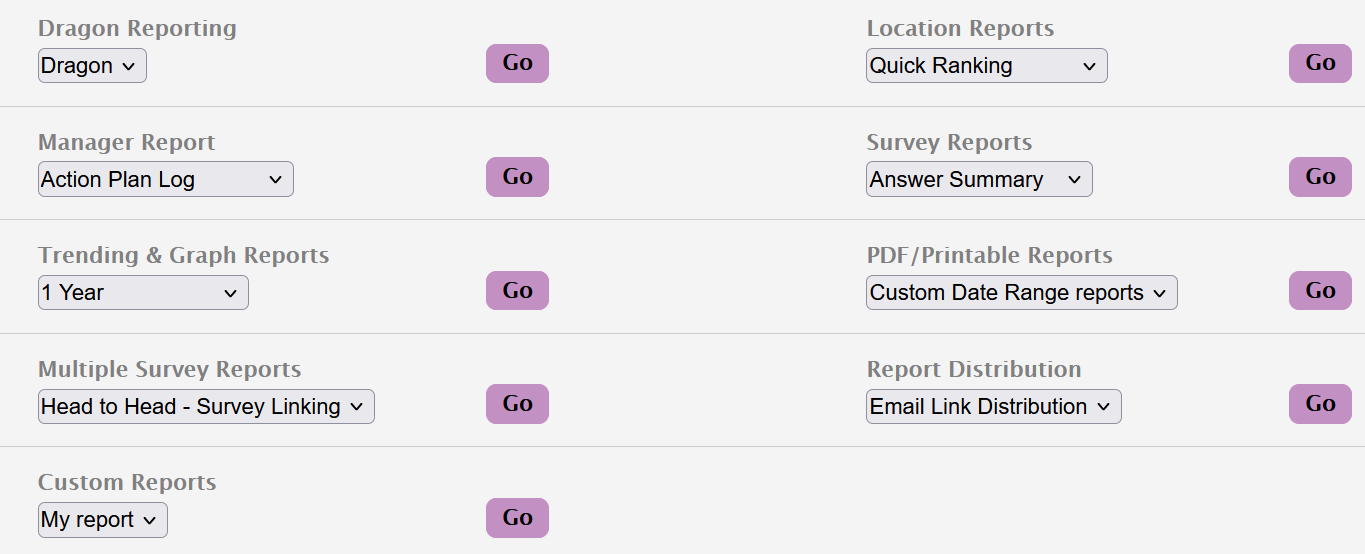
To reach a report, simply use the GO button next to it.
 You can read more about each type of report in a different section of the knowledge base.
Generating Data
Most of the reports will have the same set of buttons embedded below the report filters.
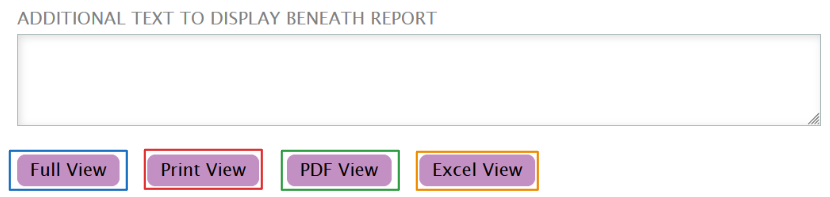
Use the Full View button to display all the generated information on the screen below the filter bar. The Print View button will open a new tab in your browser, displaying only the generated data.
The PDF View button will generate a PDF, while the Excel View button will create an Excel file containing the filtered data.
Data Mining
If Data Mining has been enabled on the survey, an additional filter will be available on some of the reports.

In cases like that, the data can be additionally filtered by Overall Scoring, Shopper Demographics, and Survey Questions.
Dragon Reporting
Dragon is our reporting system that is highly customizable and can actually replace most of the older core reports listed above. Dragon is the default landing page for most clients, but if you leave Dragon to browse other client pages, you can get back to it here.
Location Reports
The Company Overview report shows shop counts, overall scores, and major sections for each level all the way down to locations within the selected date range.
The Exception Analysis report allows you to quickly identify exceptionally good or poor levels, locations, or shops by filtering out overall or sectional scores within a defined range.
The Quick Ranking report ranks a selected portion of the company based on overall or sectional scores.
The Quick Shops report displays a list of all shops for a given portion of the company.
Survey Reports
The Answer Summary report shows the breakdown of answers for selected questions within the selected date range.
The Data Mining report displays the answers for a question in a table format showing the shop counts and percents for each selected answer option.
The Survey Summary report displays a summary of all survey questions, indicating the percentage response for each answer option or the average response.
The Survey Trending report displays average overall, sectional, or question scores over a selected date range.
Trending & Graph Reports
The 1 Year report displays the trending data over a year for overall and sectional scores.
The Answer Summary report displays the breakdown of answers for selected questions within the selected date range.
The Multi-Period report is a trending report that supports flexible date ranges and two view modes while displaying a breakdown of shop scores across the periods.
The Survey Trending report displays average overall, sectional, or question scores over a selected date range.
Multiple Survey Reports
The Head to Head - Survey Linking is not a report, but a configuration page used by ToolZ reports. The main purpose is to tie sections from different surveys within a single client.
The Multiple Survey report gives a summary for each survey for the client, and then an overall summary of all the surveys averaged together.
Manager Report
The Action Plan Log report displays active Action Items or shops for the selected survey, for the user that is currently logged in.
The Change Request Log report allows you to view the change requests that have been generated for specific shops.
The Manager Login report displays the manager name, the number of logins, and the last login date for client managers.
The Manager Report displays the average overall and sectional scores broken down by a selected manager type.
PDF/Printable Reports
The Custom Date Range report generates a PDF of Client Shop Views.
The Monthly & Annual Reports generates an archive of monthly/periodic and annual PDFs.
Report Distribution
The Email Link Distribution report allows distribution of shop links to all levels of client managers.
Custom Reports
Any custom reports created specifically for the client will appear in this pull-down.